Ecosystem
Cross-chain swaps explained: one swap across Ethereum, Base, Arbitrum and Optimism
· 4 min read
If you've ever tried to move value from one blockchain to another, you know the old workflow: find a bridge, deposit your asset, wait for confirmations, receive a “wrapped” version on the destination chain, then finally go trade it. It's slow, it introduces a new smart contract you have to trust, and it has been the source of some of DeFi's largest hacks. Cross-chain swapping through a routing engine like LCX Liberty DEX removes that entire workflow. Here's how, and what's actually happening under the hood.
The old way: bridge first, trade second
Blockchains are isolated by design. Ethereum doesn't know what's happening on Arbitrum, and Arbitrum doesn't know what's happening on Base. To move an asset between them, someone has to lock it on the source chain and mint a representative version on the destination chain. That is what a bridge does, and that representative version is a “wrapped” token.
This creates two separate risk points. First, bridge contracts are high-value targets: a bridge is effectively a large pool of locked assets secured by its own, often less battle-tested, code, and bridge exploits are among the largest losses DeFi has seen. Second, a wrapped token is only as good as the bridge backing it. If that bridge is compromised or loses solvency, the wrapped asset can depeg from the real thing even if the original chain is perfectly fine.
And practically, it is just tedious: bridge, wait, confirm, then separately go find a DEX on the new chain and trade.
The new way: one quote, one flow
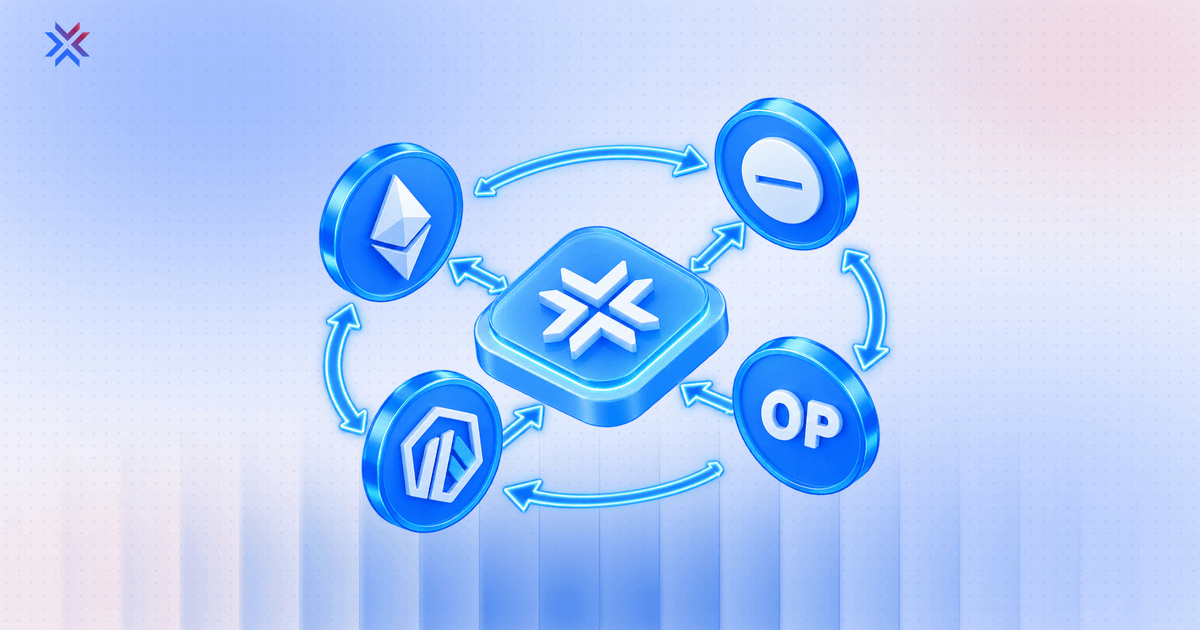
A cross-chain-aware routing engine collapses that into a single action. On LCX Liberty DEX, a swap between assets on two different supported chains (Ethereum, Base, Arbitrum One and OP Mainnet) is priced and executed as one flow rather than handled as a separate manual step. You get one quote up front that already accounts for gas and routing costs, and the minimum you receive is enforced by the contract itself.
You never hold a wrapped token as an intermediate step, and you don't have to think about the mechanics of moving value between chains. That complexity is absorbed into the routing layer instead of being pushed onto you.
What's actually happening behind that one quote
It helps to understand this isn't magic. It's the routing engine doing coordinated work across chains:
- Liquidity discovery. The engine indexes pools across all supported networks (LCX Liberty DEX prices against more than 450,000 pools spanning Ethereum, Base, Arbitrum One and OP Mainnet, per dex.lcx.com, September 2026), so it knows where the best liquidity for each leg of your trade actually sits.
- Route construction. For a cross-chain order, the engine constructs a path that may involve swapping on the source chain, moving value across, and swapping again on the destination chain, all costed out together rather than sequentially and separately.
- Net-value ranking. Routes are ranked by what actually reaches your wallet after gas on both chains, not by whichever route shows the flashiest headline exchange rate. That matters, because a route with a great advertised rate but expensive gas on the destination chain can leave you worse off than a slightly less flashy route that is cheaper end to end.
- Order splitting. For larger trades, the same logic that splits a single-chain order across multiple pools applies to each leg of the route, on the source chain and on the destination chain, reducing price impact on either side.
What to check before you trust a cross-chain route
Cross-chain swapping removes a category of risk, but it does not remove the need for basic diligence. Before confirming a route:
- Check that the destination amount is a real minimum, not an estimate. A reliable quote states the guaranteed minimum you will receive on the other chain, not a hopeful headline number that can move against you.
- Confirm the platform is non-custodial end to end. You should be signing transactions from your own wallet, never depositing funds into a platform-controlled account to be held while a cross-chain trade settles. If you want the longer version of why that distinction matters, it is what non-custodial actually means.
- Look at estimated time to arrival, not just price. How long a cross-chain leg takes varies with conditions on both networks. Know what you are waiting on before you confirm.
- Verify chain and pair support before assuming. Cross-chain execution has been rolling out pair by pair as routing engines mature, so it is worth letting the interface confirm what a specific pair can currently do rather than assuming every asset on every chain is instantly routable.
- Understand you are still paying real costs. “No bridge” does not mean “no cost”. You still pay the underlying pool fees and network gas on both chains. What a good aggregator does is price that into the quote up front instead of surprising you afterward.
The takeaway
Cross-chain swaps used to mean bridge, wait, and hope your wrapped asset stays pegged. A routing engine folds that into a single non-custodial flow: one quote with gas and routing costs included, and no wrapped-asset step for you to manage. The risk does not disappear entirely, since you are trusting the routing engine's execution, but it is a meaningfully smaller and more transparent surface than the old bridge-then-trade workflow.
This is the cross-chain case of the same routing problem a DEX aggregator solves within a single network. You can see a live cross-chain quote yourself at dex.lcx.com, with no deposit or account required to check pricing.